Table of Contents
XING is a German professional networking platform focused on jobs, recruiting, and business networking, while LinkedIn serves as the more global counterpart-creating a unique dual-platform landscape in Germany.
For international businesses, this means one thing: social media strategies cannot simply be copied from other markets. Germany operates differently. Platform usage, expectations, and even user behavior vary-and ignoring this can lead to underperforming campaigns.
Unlike markets where one platform dominates, Germany has long maintained a parallel system. While LinkedIn has grown significantly, XING still plays a role in specific use cases, particularly around recruiting and local business networking.
This is why MONSOON is covering this topic. For brands entering the German market, understanding where and how to show up is critical-and often more nuanced than expected.
Understanding XING: The “German LinkedIn”
XING is a career-focused platform centered around jobs, recruiting, and professional networking-not a social media platform in the traditional sense.
The platform defines itself like this: “XING is the leading job network in German-speaking countries.[…] It’s not just about the resume, but about the “perfect match” between applicant and suitable company culture.”
Originally, XING was the dominant professional network in German-speaking countries. For many years, it served as the primary platform for business connections, job searches, and industry groups-well before LinkedIn gained traction in the region.
In recent years, its role has clearly shifted, and in 2021 its CEO rejected a direct comparison with Microsoft subsidiary LinkedIn, pointing out its significantly different philosophy.
XING is no longer a content-driven platform where brands build visibility through regular posting and engagement. Instead, it is primarily used for recruiting, employer branding, and maintaining a professional presence.
Most users are on XING to manage their careers, explore job opportunities, or be found by recruiters-not to consume content or interact with brands. Instead of a content-heavy feed, the homepage is structured around job recommendations, showing users curated roles that match their profile and experience.
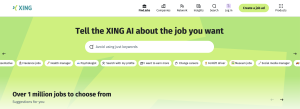
As a result, content marketing and thought leadership are not primary growth drivers on XING.
A key differentiator is its local focus. XING emphasizes regional events, industry groups, and what is often referred to as “Feierabend culture”-networking after work in a more informal, local setting.
Its strong stance on data privacy also aligns with German user expectations, making it particularly relevant for professionals who value control over their personal information.
LinkedIn’s Growth in the DACH Region
LinkedIn has seen rapid growth in the DACH region over the past five years, evolving from a niche platform for international professionals into a mainstream channel for B2B marketing and communication.
For a long time, LinkedIn in Germany was primarily used by internationally oriented executives, expats, and professionals working in global companies. It was seen as the “international version” of professional networking, while XING dominated the local market.
This has changed significantly.
Today, LinkedIn is widely used across industries and company sizes-from startups to large corporations. It has become a central platform for B2B content marketing, social media ads, employer branding, and thought leadership in Germany.
More importantly, user behavior has shifted. Professionals are not only present on LinkedIn-they are active. They consume content, engage with posts, and increasingly use the platform to stay informed about industry trends and business developments.
For brands, this creates a very different opportunity compared to XING. Visibility on LinkedIn is driven by content. Regular posting, clear positioning, and consistent messaging can build reach and authority over time.
This is why LinkedIn is now a key channel for companies looking to establish a presence in the German market-not just for recruiting, but for building credibility and generating demand.
Head-to-Head: XING vs. LinkedIn for Brand Promotion
XING and LinkedIn serve different roles in the German market. LinkedIn is a content-driven platform for visibility and engagement, while XING is primarily used for recruiting, local networking, and maintaining a professional profile.
For brands, this means the platforms are not interchangeable. They support different goals and require different approaches.
| Aspect | ||
| Core Purpose | Content, networking, B2B marketing | Jobs, recruiting, local networking |
| User Behavior | Active, content-driven | Profile-based, job-focused |
| Content Reach | High organic reach possible | Very limited |
| Advertising Strength | Scalable B2B lead generation | Targeted professional audience (DACH) |
| Geographic Focus | Global | Primarily DACH |
Engagement and Content Reach
LinkedIn is built around content and interaction. Users actively engage with posts, share insights, and participate in discussions, making it a strong channel for thought leadership and brand visibility.
In contrast, XING is rarely used for content consumption. Most users treat it as a static professional profile-closer to a CV database than a social feed. Even when content is published, it rarely generates meaningful interaction.
As a result, LinkedIn users are far more likely to engage with business content-through likes, comments, and shares-allowing brands to build organic reach over time.
For companies, this has clear implications: LinkedIn enables content-driven visibility, while XING plays little to no role in content-led marketing strategies.
Looking to enter the German market more effectively? Download MONSOON’s German Market Entry Checklist for key insights and practical next steps.
Advertising and Targeting Capabilities
LinkedIn offers advanced advertising and targeting capabilities, making it a strong platform for scalable B2B marketing and lead generation.
Its ad platform allows detailed targeting based on job title, seniority, industry, company size, and behavior. Combined with AI-driven optimization, this enables highly targeted campaigns with measurable KPIs such as cost per lead and conversion rates.
XING, on the other hand, positions its advertising offering differently. Rather than focusing on content distribution, it emphasizes access to a large pool of first-party professional data. According to XING, the platform includes over 21 million profiles, with around 100,000 new users joining each month. A significant share of users are decision-makers, and many indicate openness to new job opportunities.
XING offers several advertising formats, including:
- Native placements in industry newsletters (Content Ads)
- Display campaigns via the XING Audience Network
- Direct ads on the platform
- Email-based campaigns (XING Mailings)
- Video ads
- A self-service tool for campaign setup and management
Another key factor is data privacy.
XING highlights GDPR-compliant data processing within the EU as a core advantage-something that resonates strongly with German businesses.
In practice, this means that while LinkedIn is often used for performance-driven campaigns and content-led lead generation, XING can be effective for targeted outreach, recruiting, employer branding, and reaching specific segments of the German Mittelstand.
Is It Worth Promoting Your Brand on XING in 2026?
Promoting a brand on XING in Germany in 2026 can be worthwhile-but only for specific goals. It is not a general-purpose marketing channel like LinkedIn.
XING is effective for reaching professionals in Germany, including decision-makers and employees. This makes it relevant not only for recruiting, but also for workplace-related B2B services.
For example, services such as office catering, employee benefits, SaaS tools, HR solutions, or workplace-related products can be well positioned on XING. In these cases, the platform allows brands to reach users in a professional context, where such offers are directly relevant.
Its strength lies in targeted outreach rather than content-driven visibility. It is not suited for brand awareness, thought leadership, or community engagement.
For most brands, this leads to a complementary setup: LinkedIn drives visibility and demand, while XING supports targeted campaigns.
The Verdict: Building a Winning German Market Strategy
There is no single “right” platform for Germany-only the right combination.
LinkedIn and XING serve different purposes, and successful brands understand how to use both within a broader strategy. LinkedIn is the primary channel for visibility, content, and demand generation. XING, on the other hand, can complement this with targeted access to German professionals, especially in specific industries or use cases.
The key is not choosing one over the other, but aligning platforms with clear business goals.
For international companies, this is where things often become complex. Entering the German market requires more than just selecting channels. It involves adapting messaging, understanding platform dynamics, and building campaigns that reflect local expectations.
What works in one market does not automatically work in Germany. Platform strategy, tone of voice, and targeting all need to be adjusted to fit the local context.
A successful setup typically combines content-driven visibility on LinkedIn with more targeted, use-case-specific campaigns-where platforms like XING can play a supporting role.
Mastering the German Market with MONSOON
Turning this strategy into measurable results requires more than platform knowledge-it requires execution that is aligned with the German market.
This is where MONSOON supports international brands.
The agency helps companies navigate German expansion by combining market understanding with performance-driven marketing. This includes adapting messaging to local expectations, selecting the right channels, and executing campaigns across platforms such as LinkedIn Ads, Google Ads, and other paid media.
Beyond channel execution, MONSOON focuses on building systems that perform. Content marketing, paid acquisition, email marketing, and conversion rate optimization are aligned to ensure that campaigns not only generate visibility, but drive qualified leads and revenue.
The focus is always on relevance. Campaigns are tailored to German audiences, platforms are used based on their actual strengths, and messaging is adapted to fit the cultural and business context.
For companies entering Germany, this reduces the risk of misalignment-and increases the likelihood that marketing efforts translate into real growth.